Trade Tools

Volt Drop & Cable Size

Cable size, volt drop, BS 7671.

in testingelectriciansiteandroid

Pick the smallest copper cable for a circuit from the design current, device rating, route length, installation method and correction factors, with the BS 7671 Appendix 4 volt drop check shown in full.

How it works, a worked example and screenshots ↓

Pay once, no subscription, no ads.

Platform
Android
Version
1.0
Source
Private source · Studio product
Price
£3.99

Runs on your phone, no internet needed. When it is on Google Play, updates will come through Play next time you're online.

Want to know when it launches? Email forestforge.dev@gmail.com.
Volt Drop & Cable Size artwork
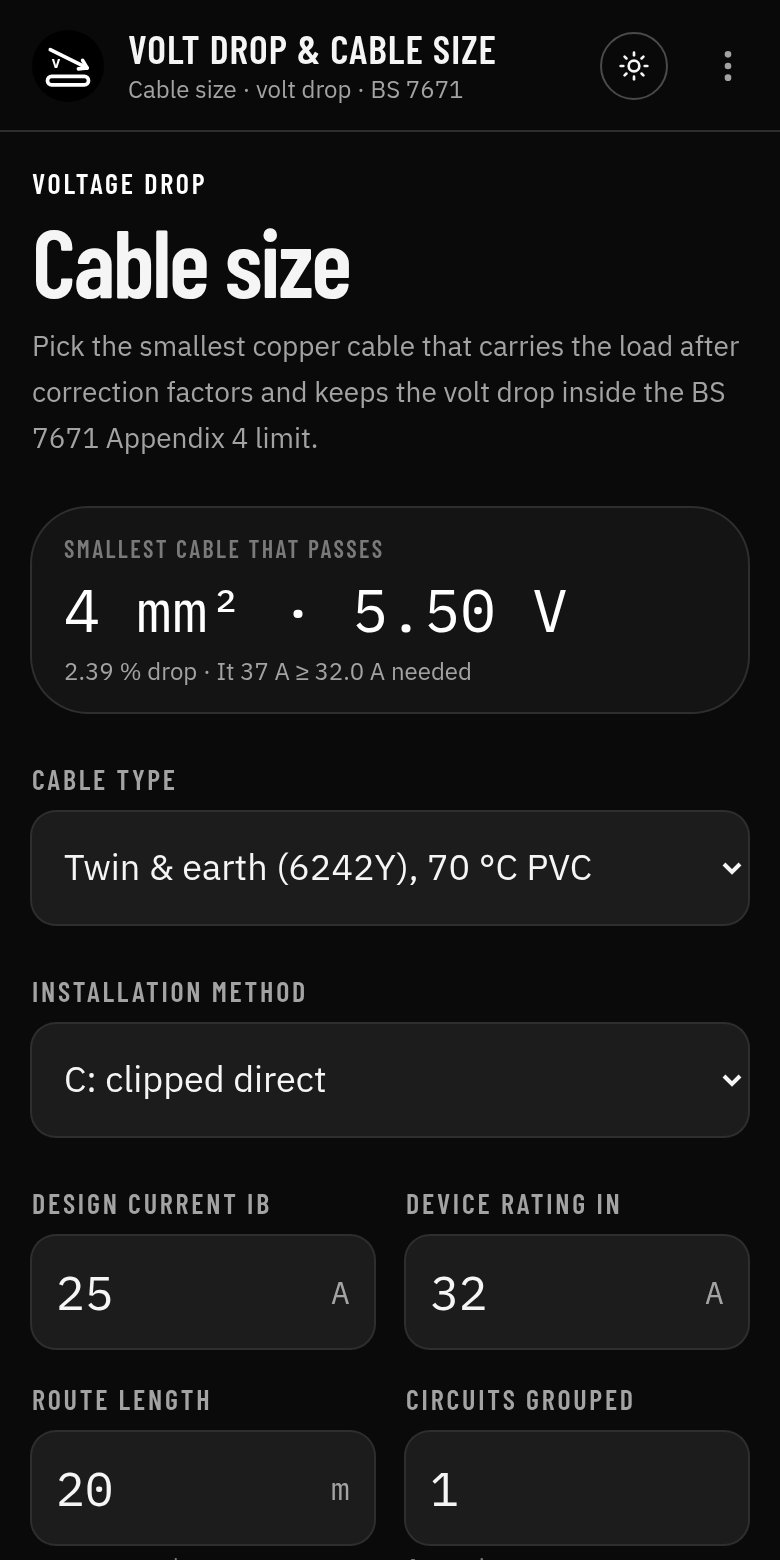
Volt Drop & Cable Size app screen
Screenshot from the Android app

What it does

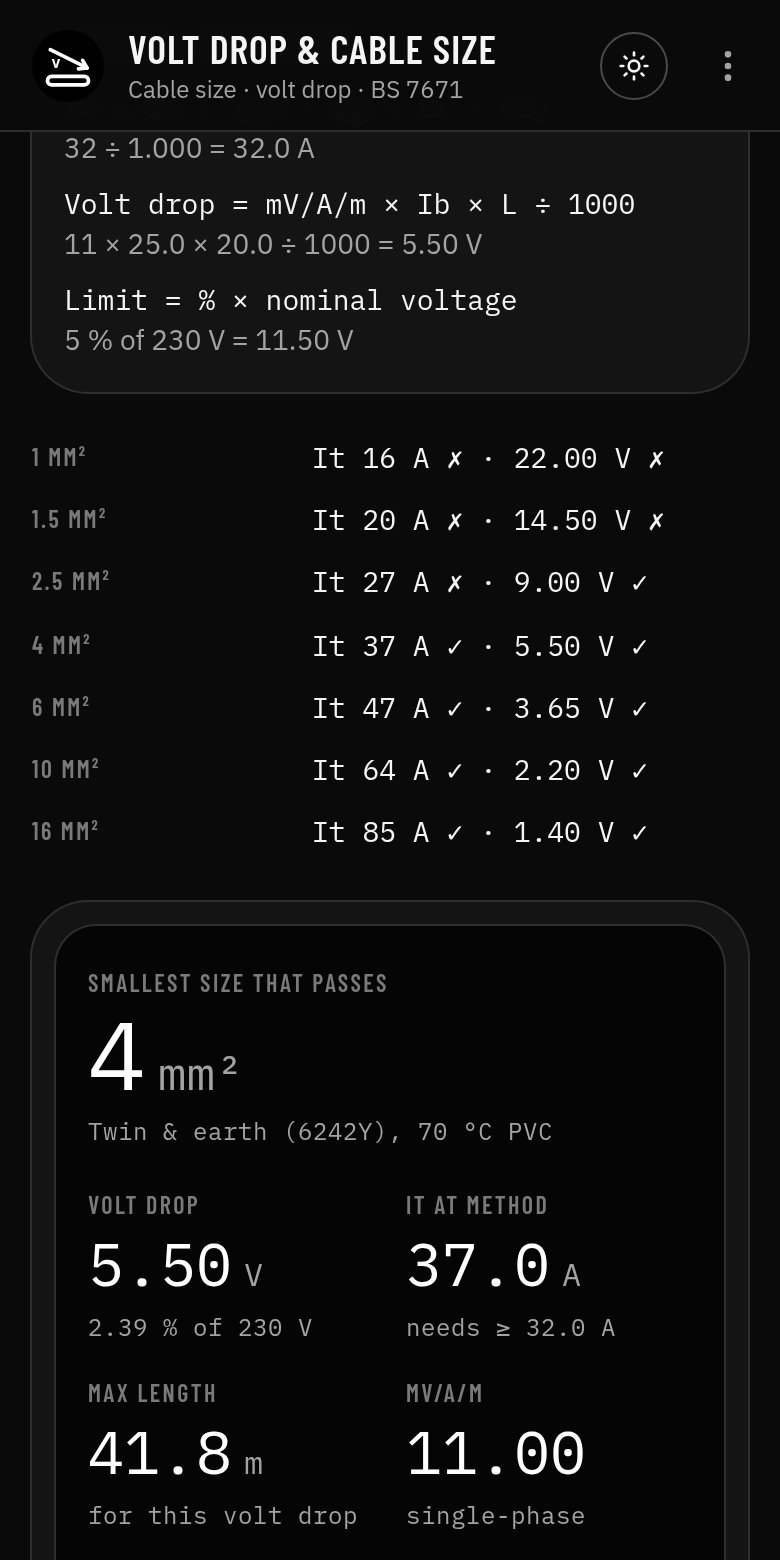
Volt Drop & Cable Size picks the smallest copper cable that will carry a circuit's load and still keep the voltage drop inside the BS 7671 Appendix 4 limit. It applies the correction factors for ambient temperature, grouping, thermal insulation and the protective device, then checks every size from 1 mm² up so you can see why the smaller ones fail.

Who it's for

Electricians designing or checking final circuits and sub-mains: showers, cookers, EV chargers, garden supplies and long radial runs.

How to use it

  1. 1Choose the cable type and the installation reference method.
  2. 2Enter the design current (Ib), the protective device rating (In), the one-way route length and how many circuits are grouped.
  3. 3Set the volt drop limit (3 % lighting, 5 % other) and any drop already used upstream.
  4. 4Adjust ambient temperature, grouping, insulation and device type if they differ from the defaults.
  5. 5Read the smallest size that passes, then copy, print or send it to the Electrician Suite job.

Inputs and outputs

You enter

  • Cable type: twin and earth, singles in conduit or trunking, or 2-core / 3-and-4-core SWA
  • Installation method (C, 100–103, A)
  • Design current Ib and device rating In (A)
  • Route length, one way (m), and circuits grouped
  • Volt drop limit and drop already used upstream (%)
  • Ambient temperature, grouping arrangement, thermal insulation and device type

You get

  • Smallest cable size that passes both current-carrying capacity and volt drop
  • Volt drop in volts and as a percentage of 230 V
  • Tabulated It at the chosen method against the It needed
  • Maximum length for this cable and load
  • A pass or fail line for every size from 1 mm² to 16 mm²

Worked example

A 32 A radial, 20 m run, clipped direct

Given

  • Twin and earth, method C (clipped direct)
  • Ib 25 A, In 32 A, route 20 m, on its own
  • 5 % limit, 30 °C ambient, no insulation, MCB

Working

  1. It needed = 32 ÷ (1.0 × 1.0 × 1.0 × 1.0) = 32.0 A
  2. 2.5 mm²: It 27 A, too small
  3. 4 mm²: It 37 A, passes
  4. Volt drop = 11 mV/A/m × 25 A × 20 m ÷ 1000 = 5.50 V
  5. Limit = 5 % of 230 V = 11.50 V

Result

4 mm² passes: 5.50 V drop (2.39 %), It 37 A against 32 A needed, good for up to 41.8 m.

An example only: your job will differ, so check the figures against the working in the app.
Features

  • Smallest cable for the load, length and method, with BS 7671 volt drop shown
  • Correction factors for ambient, grouping, insulation and rewireable fuses
  • Every size checked side by side, so you can see why smaller ones fail
  • Maximum run length for the chosen cable
  • Formulas and working shown, with a clear guide-only note
  • Copy, print to PDF, export JSON or open the result in the Electrician Suite
  • Works offline, no account, no ads

Screenshots

The tool with its starting values
Formulas, working and the results panel

Guide only

Tabulated figures are the usual published BS 7671 Appendix 4 values. A guide only: check against the regulations and the cable maker's data. The app shows its formulas and working so you can check every figure. It is not a substitute for your own judgement, training or the published standards.

More electrician tools

All electrician tools